

Super User
PHAROS
PHAROS aims to be the stepping stone bridging the two phases set by the EU in their Implementation Plan for the Ocean Mission to protect and restore the marine ecosystem and biodiversity. To achieve this, the PHAROS consortium has set seven objectives. The first objective will be to engage in citizen and other stakeholder engagement, co-creation and citizen science for community-led biodiversity solutions. To achieve this PHAROS will establish Living Labs and develop stakeholder engagement tools and guidelines. The second objective will demonstrate the relevant innovative nature-based solution for ecosystem restoration in multiple demo sites in the Atlantic and the Arctic (Mission phases 1 and 2) to boost coastal resilience through restored and resilient coastal ecosystems. This will be achieved by deploying four demos, of which two are in Gran Canaria, one in Ireland and one in Iceland. The third objective aims to extend to large areas of the Atlantic, EU AOM islands and Arctic, the BLUE4ALL project Marine Protected Area (MPA) Blueprint platform and network for successful co-management of MPA issues, including identification, categorisation, adaptive management practices, governance and corridor integration. Therefore, PHAROS will add innovations to the Blueprint platform for collective action and the set up of ecological corridors. The fourth objective has the aim to fundamentally change perception of roles by implementing fisher and citizen Guardians and Cleaners of the sea programs to address ocean pollution (Mission Phase 1 and 2). Therefore, PHAROS will enhance and roll out the fisher guardian (from NETTAGplus project) program and citizen litter entrepreneur (from REMEDIES project) program. PHAROS will develop both programs to become end-to-end circular economy solutions. With the fifth objective PHAROS will assist local entrepreneurs and SMEs co-create multiple demo based NBS business plans, host investor brokerage events, and for Associated Regions co-created replication roadmaps with systematic biodiversity and ecosystem restoration solutions for the AA basin and beyond, based on project results with innovative business models and sophisticated modelling (Mission phase 1 and 2). This will be done by sharing knowledge and data and by the creation of tools and guidelines. The sixth objective has the aim to extend the Network of Blue Schools to the AA basin to improve ocean literacy across school communities and support citizen science (Mission phase 1 and 2). Therefore, PHAROS will team with Mission project PROBLEU to ensure that the next generation continues the EU Mission objectives, increase awareness and involvement in ocean biodiversity and ecosystem restoration, and optimally employment in the Blue Economy. The last objective has the aim to provide active support to the EU data transfer object (DTO) by building a local DTO of two regions in Gran Canaria and Iceland, and by making the PHAROS project output interoperable with the EU DTO (Mission enabler phase 1 and 2). This will be achieved by real-time data monitoring at the demo sites.
BMRS’ Role
BMRS will deploy the third demo located in Ireland. This demo consists of a kelp farm cultivating winged (Alaria esculenta) and sugar (Saccharina lattisima) kelp. In this demo the effect of a salmon farm, located near the seaweed farm, on the growth of the kelp will be monitored and compared to a control side. The effect of the seaweed form on the biodiversity at the demo site will also be monitored.
Impress
The overall vision of IMPRESS is to develop a series of innovative actions to address key sustainability challenges associated with the marine and freshwater sectors from sea to shelf.
The key challenges that IMPRESS will address are:
- Valorisation of solid and liquid waste streams from fish processing.
- Utilisation and promotion of underutilised low trophic species.
IMPRESS aims to co-create, deliver, and promote new products and improved processes from freshwater/ marine low–trophic species (LTS) and waste.
Impress will use state-of-the-art technologies (hydrodynamic cavitation, microwave and enzyme assisted extraction, supercritical fluid extraction, etc.) to process solid and liquid side/waste streams from selected lower trophic species and process water from the cooking step at a seafood canning facility to obtain novel products such as proteins, chitosans and lipids. The properties (prebiotic, antioxidants, antihypertensive, etc.) of these products will be validated in vitro through biochemical or enzymatic methods. Microbiological and chemical characterization of the products intended for food application will be carried out to confirm compliance to microbiologic and heavy metals criteria in food. Techno-functional properties of proteins will be determined. Biopolymers obtained from the process streams will be assessed and used for biodegradable packaging material. Furthermore, the potential of the nutrient rich processed water will be used to support duckweed and microalgae growth. Bio-actives from macro, micro algae and duckweed will be formulated to produce bio-fertilizers and bio-pesticides for agriculture applications and vegan fishlike products. Moreover, six fresh and marine water lower trophic species will be employed for non-vegan food products and ingredients.
BMRS’ Role
BMRS will cultivate winged kelp (Alaria esculenta) next to a salmon farm in Bantry Bay forming an incidental integrated multi trophic aquaculture system. The same kelp will be grown at a control side in Toormore bay. The monthly growth off the kelp will be monitored and samples will be analysed for phenolic compounds, phlorotannin, fucoxanthin, total polysaccharides and fucans. During the growing season light and temperature will be monitored by probes and water samples will be analysed for nutrient content in the lab.
BMRS will also supply the cultivated seaweed to several partners for the development of novel food and non-food products.
Antón Seoane BSc.
Role: Asparagopsis Project Lead
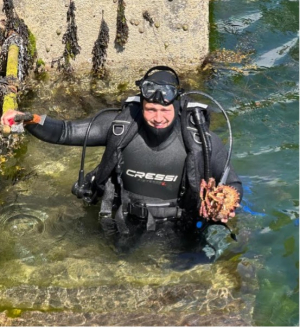
Antón Seoane oversees the strategic development and execution of all R&D activities required for the land-based production of Asparagopsis armata tetrasporophytes. He holds a BSc. in Oceanography from the University of Vigo and is a certified commercial diver.
In his role, Antón leads initiatives to optimize Asparagopsis cultivation systems aimed at reducing enteric methane emissions in cattle thus supporting the company’s commitment to delivering evidence-based, sustainable solutions for the livestock sector. He also evaluates emerging applications of Asparagopsis within the cosmetic and potential pharmaceutical domains.
Can coastal and marine carbon dioxide removal help to close the emissions gap
Johnson, M, van Doorn, E, Hilmi, N, Marandino, C, McDonald, N, Thomas, H, Allemand, D, Delvasto Algarin, L, Lebleu, L, Ho, DT, Oloyede, M, Safa, A, Swarzenski, P. 2024. Can coastal and marine carbon dioxide removal help to close the emissions gap? Scientific, legal, economic, and governance considerations. Elementa: Science of the Anthropocene 12(1). DOI: https://doi.org/10.1525/elementa.2023.00071
Read the article.
Potential nutrient, carbon and fisheries impacts of large-scale seaweed and shellfish aquaculture in Europe evaluated using operational oceanographic model outputs.
Johnson M, Jutard Q, Jaouen M, Maltsev N, Boyer M, Guillerme C, McElligott D, Paolacci S, Maguire J, Mangin A and Bryère P (2024) Potential nutrient, carbon and fisheries impacts of large-scale seaweed and shellfish aquaculture in Europe evaluated using operational oceanographic model outputs. Front. Mar. Sci. 11:1405303. doi:doi.org/10.3389/fmars.2024.1405303
Read the article.
Bioaccumulation, biodistribution, and transformation of polyvinylpyrrolidone-coated silver nanoparticles in edible seaweeds
Quarato M., Rodriguez-Lorenzo L., Pinheiro I., López-Mayán J.J., Mackey M., Moreda-Piñeiro A., Spuch-Calvar M., Maguire J., Bermejo-Barrera P., Correa-Duarte M.A., Espiña B. (2024) Bioaccumulation, biodistribution, and transformation of polyvinylpyrrolidone-coated silver nanoparticles in edible seaweeds, Science of The Total Environment, 174914, ISSN 0048-9697.
Read the article.
Development of a novel recirculatory multitrophic peatland system for the production of high-value bio-based products at scale embracing zero waste and pollution principles to unlock sustainable development goals
Rowan, N.J., Fort A., O'Neill E.A., Clifford E., Jansen M., Helfert M., Toner D., Maguire J., Tiwari B. (2024) Development of a novel recirculatory multitrophic peatland system for the production of high-value bio-based products at scale embracing zero waste and pollution principles to unlock sustainable development goals. Case Studies in Chemical and Environmental Engineering, Volume 9, 100763, ISSN 2666-0164.
Read the article.
Small-scale low-tropic ocean farming and coastal rural landscapes: Why the logistics of seaweed matter? Insights from Ireland for collaborative planning
Cerca, M., Sosa A., Vance C., Pollard P., Maguire J., Murphy F. (2024) Small-scale low-tropic ocean farming and coastal rural landscapes: Why the logistics of seaweed matter? Insights from Ireland for collaborative planning. Marine Policy, Volume 163, 106140, ISSN 0308-597X.
Read the article.
Investigation of biofluorescence produced by the red king crab
Juhasz-Dora, T., Thesslund, T., Maguire, J., Doyle, T.K. & Lindberg, S.-K. Investigation of biofluorescence produced by the red king crab Paralithodes camtschaticus.. Aquaculture, Fish and Fisheries, 4, e159.
Read the article.
Responsible supply systems for macroalgae: Upscaling seaweed cultivation in Ireland
Cerca, Mariana, Amanda Sosa, and Fionnuala Murphy. Responsible supply systems for macroalgae: Upscaling seaweed cultivation in Ireland. Aquaculture 563 (2023): 738996.
Read the article.